Rutherford Backscattering Spectrometry (RBS) /
Elastic Recoil Detection Analysis (ERDA)
Elastic Recoil Detection Analysis (ERDA)
Principle
Rutherford Backscattering Spectrometry (RBS) enables identification of the constituent atoms in a solid sample and determination of their depth profile, including layer thickness. This can be accomplished by irradiating the solid surface with MeV high-energy H and He ion beams and detecting the number and energy of He ions that are elastically scattered (backscattered) in the direction opposite to the incident beam.
Elastic Recoil Detection Analysis (ERDA) is a technique in which high-energy ion beams are incident at a shallow angle, and atoms in the solid that are lighter than the incident ions are detected as they recoil forward in the direction of the incoming beam. When high-energy He beams are used at a shallow incidence angle, elements lighter than He -namely hydrogen- can be detected. Thus, this hydrogen-specific analytical technique is known as Hydrogen Forward Scattering (HFS).
Diagram Showing the Basic Principle
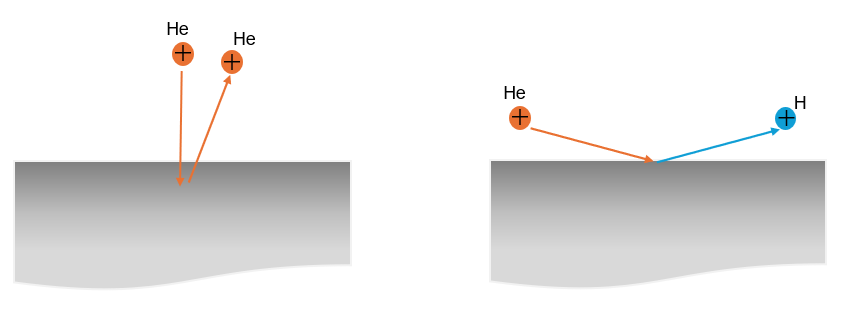
RBS ERDA
Applications
・Analysis of film composition
-Thickness of a metal film on a Si substrate
-Composition analysis of a thin film on a Si substrate
-SiN, TaN, WN, WO, TaO, HfO, AlO, SiO2, TiN, TaC, InO, Low-k film, etc.
-Silicide film: TiSix, NiSix, CoSix, etc.
-Alloy film: AuSn, etc.
・Hydrogen concentration in DLC films and amorphous silicon
・Dose evaluation of implanted elements
-Implantation of As and Sb ions into Si
・Evaluation of crystalline quality
・Crystallinity assessment of ion-implanted samples:Quantitative evaluation of implantation-induced damage and degree of recrystallization, Evaluation of the amorphous layer thickness
・Analysis of the lattice substitution fraction
Features and Limitations
<Features>
1. Allows absolute quantification without the need for standard reference samples.
2. Hydrogen and deuterium can be measured using ERDA.
3. Once the film thickness is obtained, the film density can be determined.
4. The sensitivity is on the order of 0.01% up to the percent level.
(Dependent on the atomic number. Higher atomic number → better sensitivity; Lower atomic number →
poorer sensitivity)
5. Crystallinity can be evaluated using channeling measurements.
<Limitations and Drawbacks>
1. Measurable depth is limited to approximately 1 – 1.5 μm.
2. The spectrum may be complicated depending on the combination of the film and substrate constituent atoms.
3. Mass resolution is lower for element with higher atomic numbers.
4. In low-k films, beam-induced damage including hydrogen loss may occur.
5. Flat samples are required for measurement.
6. Due to the relatively large beam diameter, micro-area analysis is difficult.
Important Notes When Making Analysis Requests
Basic Sample Information
▸Sample size: approximately 20 mm x 20 mm square and about 1 mm thick
*Larger or thicker samples may require cutting or trimming
▸Surface condition : as flat as possible
Required Information
▸Film and substrate information
-Expected film structure and constituent elements of the substrate
▸Expected film thickness
-Film thickness must be provided when the objective is to determine film density
When Sending the Sample
▸Please use a chip case, wafer case, or medicine wrapping paper when shipping (to prevent breakage during transportation).
▸Please indicate the Sample No. and ID (labeled on the back surface or on the case).