
Secondary Ion Mass Spectrometry(SIMS)
Principle
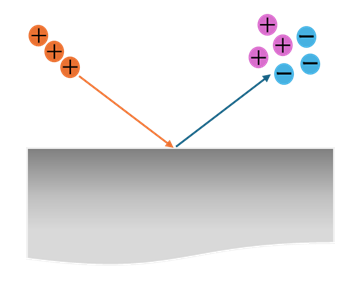
This is an analytical method that applies sputtering, which occurs when a solid surface is irradiated with energetic ions (primary ions) of several keV to several tens of keV. Ions contained in the sputtered particles are called secondary ions. By detecting these secondary ions using mass spectrometer, elements contained on the solid surface can be identified and its concentration can be measured. Furthermore, when sputtering is performed continuously, distribution in the depth direction can also be measured.
Diagram Showing the Basic Principle
Applications
・Dopant and impurities depth profile in various semiconductor materials
・Composition depth profile in III-V semiconductor multiple layers
・Impurities depth profile in glass materials
・Composition profile and impurities depth profile in High-k/Low-k films
・Mg, C, Si depth profile in GaN epitaxial layers
・Impurities depth profile in metal layers
・Analysis of impurity distribution in Gems and Minerals
Features and Limitations
<Features>
1. High sensitivity: good detection limit in the ppm to ppt range
2. Wide dynamic range: detection is available from matrix-level to trace-level
3. Quantitative analysis is possible when a good standard is present.
4. All elements including Hydrogen can be detected.
5. Isotope detection is possible.
6. Good depth resolution: 1 nm - 3 nm (at best)
7. A wide range of film thicknesses are measurable: several nm to several 10 μm
<Limitations>
1. Matrix effect
・A large difference in sensitivity among elements (over 5 orders of magnitude).
・May be the cause for complication in data interpretation.
2. There is a limit to measurable elements in one profile (different analytical conditions may be required).
3. Quantitative analysis requires a standard reference.
・In particular, standard refence samples are scarce with metallic samples.
4. Could be easily affected by the sample morphology or surface condition.
Important Notes When Making Analysis Requests
Basic Sample Information
▸Sample size: Larger than 5 mm x 6 mm up to approximately 10 mm x 10 mm, with a thickness of about 1 - 2 mm
*Larger or thicker samples may require cutting or trimming
▸Surface condition : Preferably, the surface should be as flat as possible
Required Information
▸Details of the sample structure (film structure and substrate information)
▸Expected film thickness and concentration
▸Information of the sample’s electrical conductivity
When Sending the Sample
▸Please use a chip case, wafer case, medicine wrapping paper, or aluminum foil when shipping (to prevent breakage during transportation and particle generation on the surface).
▸When placing the sample in a case, make sure it is secured so that it does not move inside.
→ For particle suppression (This is especially important when conducting measurements near the surface layer for
H, C, O, Si, and other elements.)
▸Please indicate the Sample No. and ID (labeled on the back surface or on the case).
→ Making a scribe mark at the edge of the surface is effective for particle suppression.
Application Notes

- TOP >
- Services >
- Material Analysis Services >
- Secondary Ion Mass Spectrometry (SIMS)
