Transmission Electron Microscopy (TEM) / Scanning Transmission Electron Microscopy (STEM)

Principle

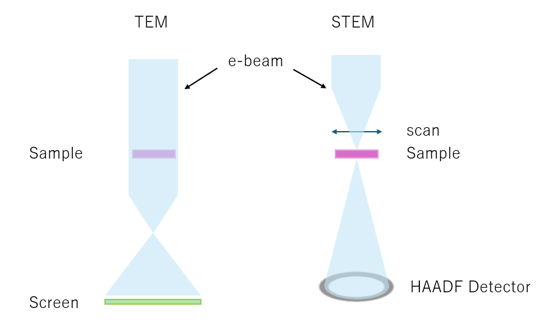
Transmission Electron Microscopy (TEM) observes samples by magnifying the electrons that have passed through it using electromagnetic lenses.  In Scanning Transmission Electron Microscopy (STEM), a finely focused electron beam is scanned across the sample, and the transmitted and scattered electrons are detected for imaging. Because diffraction contrast is dominant in TEM, crystallinity and crystal defects can be observed. On the other hand, STEM provides atomic-number-dependent contrast, which allows compositional differences to be observed. TEM and STEM imaging can be switched on the same microscope.
As analytical options, Energy-Dispersive X-ray Spectroscopy (EDX) and Electron Energy-Loss Spectroscopy (EELS) can be combined to perform compositional analysis, including point analysis, line scans, and elemental mapping.  

Diagram Showing the Basic Principle


image-png-Feb-16-2026-06-00-20-7802-AM

Differences between TEM and STEM

Applications

Internal structural observation of samples: including cross-sections of semiconductor devices, failure analysis, nanoscale particles, and fibers (such as carbon nanotubes).

Crystallinity evaluation: Crystal structure identification, defect observation (dislocations and stacking faults), and lattice-image analysis enable the assessment of epitaxial films.

In STEM, elemental analysis using EDS or EELS enables atomic-level elemental mapping and visualization of electronic-state differences, allowing precipitates to be identified.

Widely used across various materials, from semiconductors, metals, and ceramics to polymers and biological samples.

Features and Limitations

<Features>

1. Offers sub-nanometer resolution, enabling atomic-level observation

2. In TEM, crystal effects (such as orientation, thickness, and defects) can generate interference fringes that make the specimen difficult to observe, whereas in STEM these influences are much weaker.  

3. Combining STEM with EDX and EELS allows nanometer-scale compositional analysis, including point analysis, line scans, and elemental mapping.


<Limitations>

1. Sample preparation for cross-sectional observation is challenging; to allow electron transmission, the sample must be thinned from a few hundred nanometers to only a few nanometers.

2. Thin-section samples are generally fabricated using a focused ion beam (FIB), thus making the process both time-consuming and costly.

3. Not suitable for observing wide areas on the millimeter scale

4. Electron-beam damage is significant in polymers and biological samples

Contact Us

  • TOP      >      
  • Services      >      
  • Material Analysis Services      >      
  • Transmission Electron Microscopy (TEM) / Scanning Transmission Electron Microscopy (STEM)
TOP